

This walk will take us thru Montreal’s Red Light District.
The Red Light district has been around since the middle of the 19th century, in some manner, with all types of vice. It started to gain notoriety in the early 20th century, and Montreal became known as an “open city”, where the police looked the other way and gangsters ran their business quite openly. In the 1940’s brothels were very common in this area and out in the open. So much so that soldiers preparing to embark for Europe in the 1940’s were being infected with venereal disease, which compromised their readiness. It was the Canadian army that took the initiative to inspect and close down brothels. In the 1940’s and 1950’s there were two lawyers who fought the underworld as well as corruption in the police force, they were Pacifique Plante and Jean Drapeau. So as crime was being fought, there was also a post war movement on slum clearance in the city. The “Dozois Plan” called for urban renewal efforts across Montreal, targeting specific areas and neighbourhoods. One city planning director said there were 250,000 Montrealers living in slums. In a study of this area by the city in the early 1950’s they found almost no play grounds or parks for children and that youth crime was 10 times higher than other parts of the city. Prostitution was still rampant.
The northern half of the Red Light District was one of those prepared for demolition and urban renewal. All buildings (commercial and residential) between Rue St. Dominique to the west, Rue Sanguinet to the east, Rue Ontario Est on the north and Rue de Boisbriand on the south, were destroyed. In 1959, the city of Montreal then built a low-income housing project, Habitations Jeanne-Mance, in this area occupying 19 acres and is now home to 1,700 residents.
Oh yes, one other thing…we made reference to youth and crime…so we will also highlight Machine Gun Molly…most certainly a product of her environment and upbringing.
Machine Gun Molly (or Monica la Mitraille) was born Monica Proietti in 1940 in the Red Light District. She was one of seven siblings who grew-up in poverty and crime. At the age of 13 she was a prostitute to bring money in for the family, at 19 she witnessed the family home explode and burn on St. Elisabeth Street, resulting in the death of four of her siblings and her mother. Monica’s grandmother ran a “school of crime” for local children on Leduc Lane and her father would teach her the trade of stealing cars. Monica did try to go straight, but, when her husband was arrested for criminal activity and deported to Scotland she became involved with another gangster and so began a life of robbing banks at gunpoint. And Monica Proietti would become Machine Gun Molly.
So this is the area we will highlight, we will start at the historic centre of the Red Light District – the corner of St. Laurent and St. Catherine streets and slowly make our way around the area. We will walk among the streets, see a few old buildings and the housing project, as well as trying to get an image and comprehension as to what the Red Light district really was.
This is not a difficult walk and is quite short, 2.49KM (1.5miles) mostly on flat terrain.
Above map highlights the route of this walk.
1. START: corner of St. Catherine Street & St. Laurent Boulevard
2. Ontario Street
3. Avenue Joly & Rue Sanguinet
4. Ontario & Avenue Joly
5. 301 Boul. de Maisonneuve East – Old School – École Saint-Jacques; built 1923
6. 355 Boul. de Maisonneuve East – Old school – École Jeanne Mance, built 1922
7. 1250 Rue Sanguinet – Old School – Alexandra School, built 1910
8. Sainte-Elisabeth Street and Ruelle Dufault
9. 182 Rue Sainte-Catherine East – Édifice La Patrie, built 1905
10. 110 Rue Sainte-Catherine East – Église Unie Saint-Jean, built 1894-1896
11. 79 Rue Sainte-Catherine East – Édifice Chas Laforce, built 1936
12. FINISH: Ruelle Sainte-Elisabeth
Looking north on St. Laurent Boulevard (a.k.a. The Main), at the corner of St. Catherine Street.

Corner of St. Laurent and St. Catherine – circa early 1900’s (credit BANQ).

A survivor from the 1970’s – Café Cléopatra. The building was built in 1895, at 1230 St. Laurent Blvd.

Across the street is the Montreal Pool Room, a fixture in various locations on The Main since 1912 !

Inside the Montreal Pool Room, looking out.

This is what they are famous for…

Historic marker for area.

Historic marker for area.

Walking north on St. Laurent Boulevard.

When you get to Ontario Street, turn right (direction east).

You will walk right by the northern part of the Habitations Jeanne-Mance housing project.

Map highlighting the Habitations Jeanne-Mance housing project from current location.

The north side of Ontario Street was untouched and left as it was.

Habitations Jeanne-Mance housing project on south side of Ontario Street.

Habitations Jeanne-Mance housing project.

Continue walking east on Ontario Street to Sanguinet Street.

Cross Ontario Street and walk up Sanguinet Street halfway and you will come to an entrance to Joly Avenue.

Joly Avenue, looks like an alley, but is a street. We walk this street, only because its there.
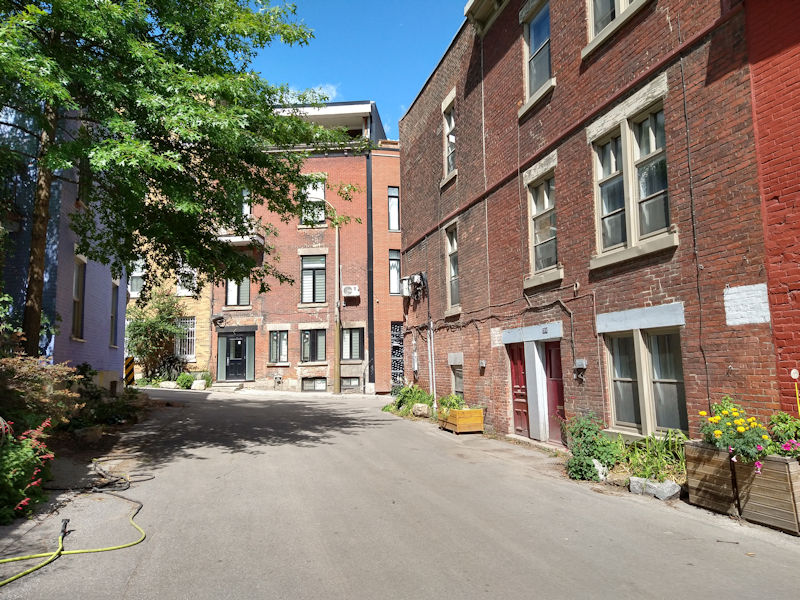
Joly Avenue.

Exit Joly Avenue on Ontario Street and walk back west to Sanguinet Street. The grey buildings in the middle housed a notorious brothel in the 1940’s.

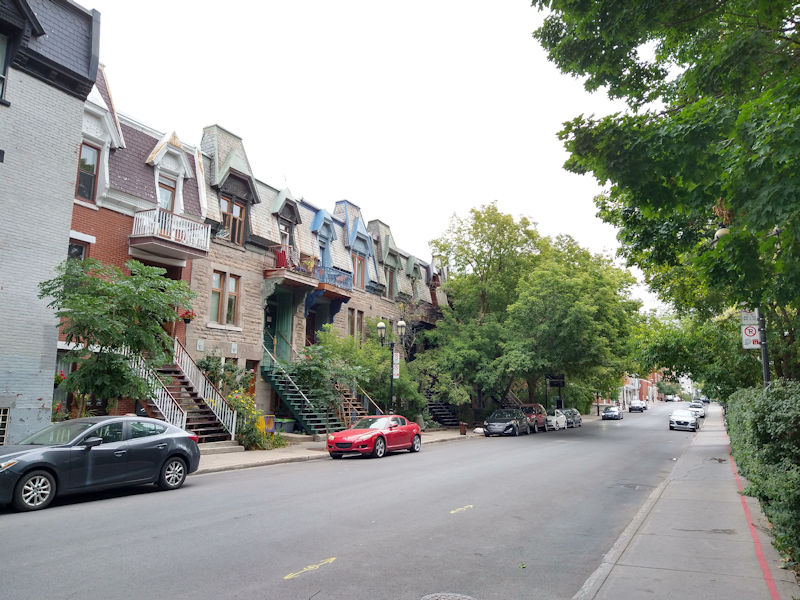
Walk south on Sanguinet Street. Beautiful homes on east side of street.
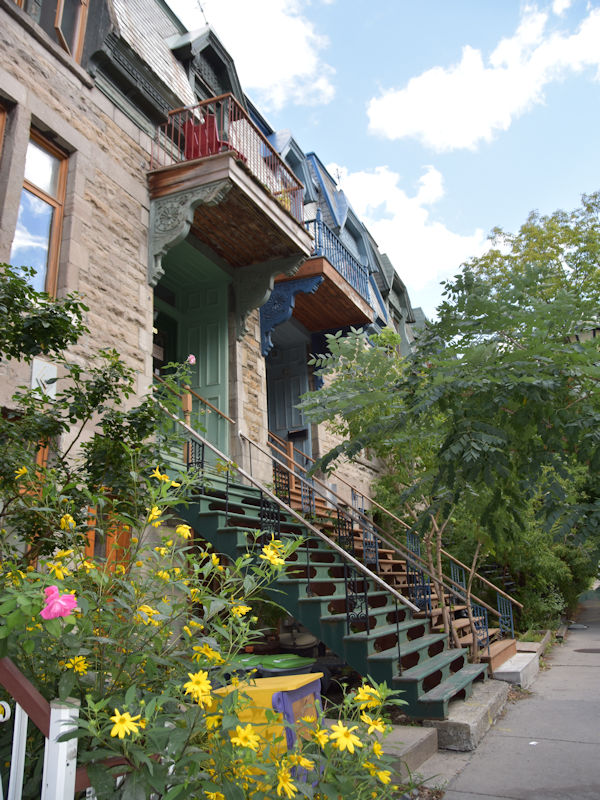
Walk south on Sanguinet Street. Beautiful homes on east side of street.
Sanguinet Street (west side) in 1957. The one house on the right is wooden (credit Archives Montreal).

On the west side of Sanguinet Street is the Habitations Jeanne-Mance housing project.

Map highlighting the Habitations Jeanne-Mance housing project from current location.

As you approach de Maisonneuve Boulevard, you will see the original École Saint-Jacques; built in 1923.

École Saint-Jacques; built in 1923 – 301 de Maisonneuve Boulevard East.

If you walk east on de Maisonneuve, half a block, you will see the original École Jeanne Mance, built 1922 at 355 de Maisonneuve Boulevard East.

École Jeanne Mance, built 1922.

Old photo of École Jeanne Mance (credit BANQ).

Walk back to Sanguinet Street and continue walking south. This is the corner of Sanguinet and de Boisbriand Streets.

Continue walking south on Sanguinet, passing St. Catherine Street, seen below.

At 1250 Sanguinet, just below St. Catherine, is this building – the original Alexandra School – built in 1910. Now under redevelopment. They are keeping the facade.

This is what the Alexandra School looked like in 2020.

Beside the school is Ruelle Dufault, walk thru it to Sainte-Elisabeth Street. You can see how only the facade of the school is being kept.

Corner of Ruelle Dufault and Sainte-Elisabeth Street.

If you walk south half-way down on Sainte-Elisabeth, you can see some beautiful buildings.

Walk back north to corner of Sainte-Catherine and Sainte-Elisabeth streets.
“Take the time to talk to someone, it makes so much of a difference “; Maurice.

Walk north on Sainte-Elisabeth Street.

Corner of Sainte-Elisabeth Street and de Boisbriand Street. Habitations Jeanne-Mance is across the street and this is where Sainte-Elisabeth Street ends, it used to run straight north thru this

Walk back down to Sainte-Catherine Street (below) and walk west to Avenue de l’ Hôtel-de-Ville.

Some buildings on Avenue de l’ Hôtel-de-Ville south of Sainte-Catherine.

Corner of de l’ Hôtel-de-Ville and Sainte Catherine. On the right is the hat maker, Henri Henri Le Chapelier, since 1932.

Édifice La Patrie, built 1905 at 182 Sainte-Catherine Street East.

Édifice La Patrie, built in 1905 at 182 Sainte-Catherine Street East.

Église Unie Saint-Jean, built in 1894-1896 – at 110 Sainte-Catherine Street East.

Église Unie Saint-Jean, built in 1894-1896 – at 110 Sainte-Catherine Street East.

Continue on Sainte-Catherine walking west, and at du Bullion Street, half-way down on the south side are some beautiful homes.

Make your way back onto Sainte-Catherine, and see the Édifice Chas Laforce & Cie Ltee, built in1936 at 79 Sainte-Catherine Street East. Beautiful Art Deco !

Continue on Sainte-Catherine Street (below) to St. Dominique Street.

Sainte-Catherine Street East, just before St. Dominique, showing Le Théâtre Français on the left, early 1900’s (postcard image).

Turn right and walk north on St. Dominique Street.

St. Dominique Street , looking north from de Maisonneuve.

Walk up St. Dominique just past de Maisonneuve, but, be prepared to go back to de Maisonneuve, Just to highlight the buildings on the west side.

Below is Rue Leduc (a.k.a. Leduc Lane) in 1957. This is where Grandma Proietti ran her “school of crime”.
Leduc Lane ran west to east, halfway between de Montigny (de Maisonneuve) and Ontario, from St. Dominique Street eastwards, ending just before it meets de Bullion.
(credit Archives Montreal).

Newspaper article on the “crime school” (credit The Gazette – Montreal Jan 18 1952). They were taught to get their hands on whatever they could!

Walking north on St. Dominique, Habitations Jeanne-Mance is on your right. This cul-de-sac could be where Rue Leduc once stood.

You need to walk back to de Maisonneuve Boulevard and walk east.

Ruelle Gravel ran north of de Montigny (de Maisonneuve) for about 1/4 of a block – photo 1957 (credit Archives Montreal).

Below image shows corner of du Bullion and de Montigny (de Maisonneuve) streets in 1957. (Credit Archives Montreal).

Continue east on de Maisonneuve, the housing project is on both sides of the street now.

When you come to this spot on de Maisonneuve, you can see beyond the parking lot is where Sainte-Elisabeth Street ends.
This street used to go right thru here, ending at Ontario Street.

On the other side of de Maisonneuve, you will see a sign for Allée Sainte-Elisabeth, that will run straight thru the Habitations Jeanne-Mance.
This is roughly where Sainte-Elisabeth street would have been.

Walking thru the housing project on this alley.

And this is where Allée Sainte-Elisabeth ends at Ontario Street. The Red Light District walk ends here.

Below image of the corner of Sainte-Elisabeth Street and Ontario Street in 1957 (credit Archives Montreal). Halfway down this street on the right was where Monica Proietti lived with her parents, seven siblings, her husband and a roomer at 1664 Sainte-Elisabeth.

At this address of 1662-1664 Sainte-Elisabeth Street was a fire in February 1958 that claimed the lives of four of Monica’s siblings and also her mother. In the middle article, it says in addition to the Proietti family, 23 other persons were made homeless. So in these two addresses lived 35 people !
(Feb 4, 5 & 6 and Mar 12,1958 – credit The Gazette Montreal)
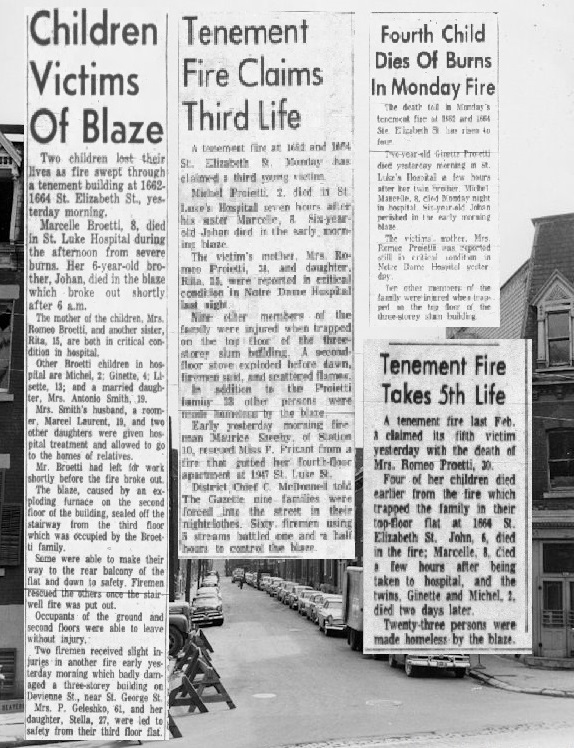
So almost out of a Charles Dickens story of poverty and crime, we can witness the environment of Monica Proietti and how it influenced and shaped her. But, we all have the freedom of choice and she chose to be an armed holdup gangster. Below headlines from various American newspapers in 1967. Keep in mind that Montreal was hosting a world fair at the same time, Expo67.

The climax of Machine Gun Molly’s heist’s was 1967, where she reportedly robbed more than two dozen banks and made off with about $100,000 (in 2021 money, with inflation, this is approximately $750,000 !)

She should have called it quits with that kind of money, but, there’s always one last heist to pull off. It didn’t go well at all.

Below excerpt of map shows the area of the slum clearance, red circle (credit Shell map 1951).

And here is another excerpt of a City of Montreal map from 1949 of same area. Leduc Lane circled in blue and Sainte-Elisabeth Street where the fire was circled in green.

So did the slum clearance have to do more with poverty than it did crime? Below from the city of Montreal Archives shows where the brothels and rooming houses were that had reported cases of venereal disease. The vast majority are in the Red Light District, but, the majority of these are all below Sainte-Catherine Street. This area was untouched during the slum clearance.

We hope you enjoyed the walk, as well as the added history. Walking, taking photo’s and learning about a neighbourhood is a good combination. If you wish to furthur this walk, you can continue west and explore the Place des Arts area, which also underwent its own changes around same time.
Bonjour,
Je suis responsable d’organiser dans le cadre d’un congrès qui se tiendra à Montréal une soirée pour les participant.e.s (± 80 à 100 pers). Le congrès porte sur la sexualité et la diversité et nous cherchons une activité à faire.
Quelles sont vos options corporatives?
Merci!